
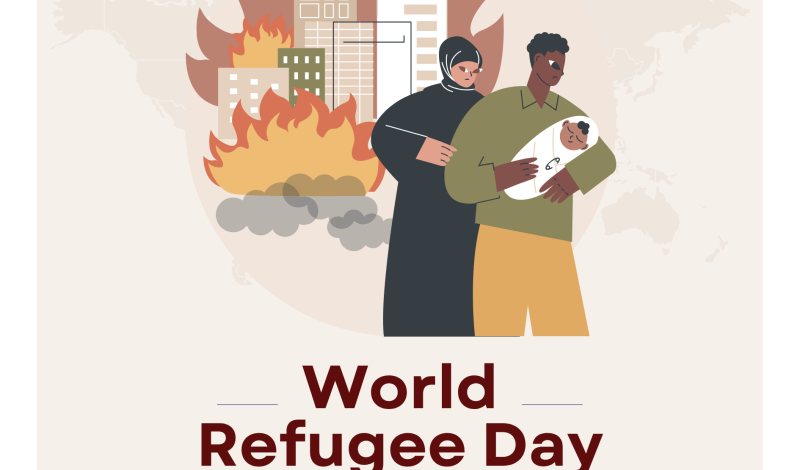

“No one leaves home unless home is the mouth of a shark.” – Warsan Shire
These powerful words by Somali-British poet Warsan Shire often echo in my mind. I shudder at the thought of ever having to flee Kenya because of insecurity. But for many of our neighbors in Sudan, South Sudan, and the Democratic Republic of Congo, this is not a distant fear it’s a lived reality.
Displacement for them is not a choice but a necessity. And in such moments of crisis, what does it mean to be a good neighbor?
In this year’s Refugee day, themed “In Solidarity with Refugees,” we are challenged to turn empathy into tangible action. As a country and a region, how are we living out this solidarity? Are our policies inclusive, and are they being implemented in ways that empower displaced communities to survive and thrive?
Kenya has long held a central role in refugee protection in East Africa, hosting hundreds of thousands of refugees across camps and urban centers. In recent years, it has taken bold steps toward progressive reform. The 2021 Refugee Act set the stage for more integrated approaches to refugee management. Building on this, the recently launched Shirika Plan envisions a transition from encampment to settlement and inclusion.
This policy framework moves beyond temporary humanitarian responses to long-term development-focused strategies. It promises access to education, employment, healthcare, and freedom of movement. In essence, it seeks to give refugees what every human being deserves: dignity, opportunity, and a sense of belonging.
One of the most significant recent developments came from the Department of Refugee Services, which announced that Refugee ID cards are now officially accepted for SIM card registration and mobile money services.
This move is more than a technical update,it is a gateway to financial inclusion and digital access. With mobile money being a lifeline in Kenya’s economy, refugees can now receive remittances, start small businesses, and access essential services previously out of reach.
But even as we celebrate this progress, we must confront the truth: many refugees still struggle to obtain valid ID cards. Without documentation, rights remain theoretical. For policies like the Shirika Plan to be meaningful, the foundational barrier of legal identity must be addressed urgently and equitably.
Solidarity must be measured not just by good intentions but by practical impact. In this regard, Uganda and Rwanda offer compelling models. Uganda’s refugee policy allows full freedom of movement, the right to work, and access to national systems. Rwanda has prioritized refugee entrepreneurship, skills development, and inclusion in its national planning frameworks.
These countries show that inclusion isn’t a burden,it’s a development opportunity. Refugees, when empowered, contribute economically, socially, and culturally to their host communities.
Kenya has the potential to lead in this space,not just by hosting, but by investing in refugees as part of our national future.
“Solidarity is not symbolic,it is systemic.”
Being in solidarity with refugees means making sure that policies are not only passed but implemented. It means investing in systems that work, documents that are accessible, and services that do not discriminate.
As a region, we are at a crossroads. We can choose to see refugees as a challenge,or we can see them as part of our shared humanity and collective strength.
To stand in solidarity with refugees is to make room,at the table, in policy, and in practice. It means giving displaced people not just a place to stay, but a place to grow.
Because no one leaves home unless they have to. And when they come knocking on our door, may they find not fences, but a future.
Deraso Dokhole is a lawyer and the head of refugee rights at The Legal Caravan.

